
Theme
Industry trends
3 min
NNG Case Study: Giving Back to OpenStreetMap through Extensive Field Testing
How an NNG team of dedicated field testers is traveling the length and breadth of Europe to give back to the OpenStreetMap community.
NNG
13 Jun, 2023
Community powers the OpenStreetMap (OSM) project: Millions of volunteers across the world working, often independently, to create, maintain, and enhance OSM’s collective mapping data. At NNG, we believe it is vital to ‘give back’ to the project, ensuring it leverages the very latest and most accurate data.
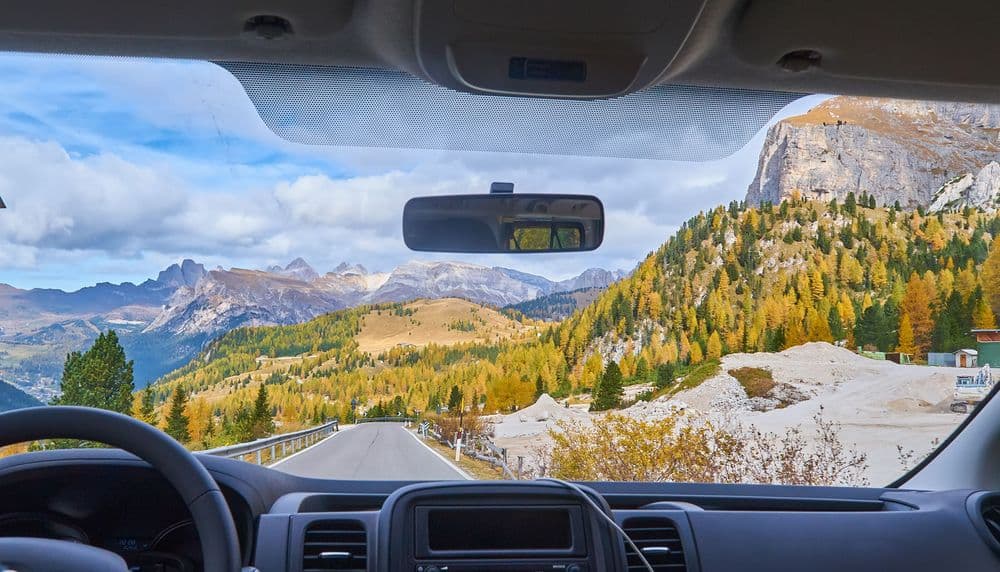
It’s why we have been undertaking several field tests across Europe. Our lead tester, Judit Szabó, explains: “OSM is created and maintained by enthusiastic volunteers, who take their time to collect and correct the map data. We want to help, so we’re aiming to reach as many countries as possible to test and update OSM’s data.” To achieve this, Judit and her team have already conducted field tests in the Alps and the US, with a tour across Slovakia, Czech Republic, and Poland also recently completed.
To ensure successful outcomes for every field trip, Judit typically packs eight navigational devices. These include built-in navigation with OSM maps, and a phone-based navigation solution to monitor traffic jams. There is also a camera set up to record the road paired with a tablet that has tracking capabilities and can display raw map data. And of course, the team also has to pack itself into the car too.
Getting lost
Every field test begins with the creation of a preplanned journey from A to B before deliberately ‘getting lost’ and challenging the OSM-based navigation solution to find the right way back. This is an ideal method for checking OSM data coverage and its impact on the navigation solution’s routing logic, i.e., to see if the navigation software is capable of offering an alternative route or simply takes the team back to the original route.
Charting the unknown
There have also been several unique test cases. For instance, the ‘Trans-Börzsöny’ route between Diósjenő and Kemence through Királyháza in Hungary, which is state-owned and the restricted property of the local Hungarian forestry service (Ipolyerdő Zrt.). Cross-navigation and reaching the private apartments of Királyháza is only possible with special permission, which must be obtained from the forestry service.
“However, when we initially planned our journey, our map sources featured the route but with no restriction warnings,” explains Judit. “After a discussion with the forestry service, we got one-time permission to go through on the understanding we’d correct any mapping data.”
Unauthorized access
This was urgently needed by the forestry as many drivers use the restricted route because their navigation systems do not highlight the route as being off-limits. For instance, in Google Maps, it was marked as a public route. In OSM’s raw data, there is a free-text description that states a special permission is needed. However, there was no special attribute that could be used for OSM’s VTR (vehicle type restriction) feature, i.e., the route was not marked as restricted on the OSM map.
To rectify this issue, Judit added a proper OSM key (‘access=private’) using the JOSM OpenStreetMap editor so the correct restriction information now appears in OSM’s raw data. The team will also add this correction to create an updated VTR value in future too.
Key strengths
The biggest takeaway for Judit during field testing to date has been the advantages of OSM. This includes its fresh road geometry for the countryside because the community is continually adding new roads to the map. Better still, our own content has provided this effective road geometry with precise house numbering to create a potential foundation for a quality navigation solution.
However, Judit does highlight issues with OSM’s existing data sets: “Compared with commercial maps, extra functions like signpost information, lane level guidance, driver alerts, and special speed limits are not at the same level.”
She also cites individual raw data errors being more frequent than those found in commercial map sources. This is in part due to the community-sourced nature of OSM. For instance, there is a correlation between the number of available editors and the quality of the data. e.g., in rural areas there are fewer editors, which leads to less reliable data.
The challenge is to correct these mistakes or oversights as map data sets need to be accurate outside of city centers as well. It’s why NNG has teamed up with a third-party commercial map providers to provide data enhancements to not only help OSM, but to also create a potential solution viable for automotive use cases in the future.
The road ahead
Moving forward, the NNG field testing team has big plans for 2023. Plans that will see it traversing Central Europe, offering updates and enhancements to OSM’s existing data sets. By adopting such a proactive ‘give back’ approach, we can help the OSM reach its full potential. Big picture, it also means we are also helping contribute to the creation of an incredibly accurate map source – one that can be used across commercial and public sectors to help us all navigate toward a better future.
Would you like to know more?
Get in touch to learn more about our latest products and services or company news


